There are far more interesting scientific phenomena hidden in the everyday foods, animals, and surroundings we encounter than we might think.
For instance, bananas are slightly radioactive, and octopuses have three hearts. Honey can last for an exceptionally long time under the right conditions, and a substantial amount of space dust enters Earth every single day.
While these stories are commonly introduced on the internet under titles like “Scientific Secrets,” it is essential to distinguish between entertaining stories and actual scientific facts.
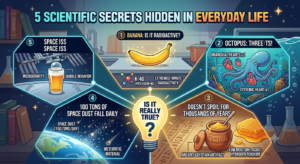
Do Bananas Really Have Radioactivity?
Yes, they do.
Bananas contain potassium, and naturally occurring potassium includes a tiny trace of a radioactive isotope called Potassium-40 (K-40). Therefore, bananas do possess an extremely minute level of radioactivity.
However, the crucial point here is that the fact that “radioactivity exists” and the judgment that “it is dangerous” are two completely different matters.
Potassium-40 is not unique to bananas. Because potassium itself is an essential element for our bodies, Potassium-40 naturally exists within the human body as well. Consequently, eating a banana gives you no reason to worry about radiation.
To explain this, a fun expression called the “Banana Equivalent Dose” is sometimes used on the internet. However, this is closer to an intuitive metaphor used to explain radiation doses rather than an official health benchmark for measuring scientific risk.
Why Octopuses Have Three Hearts
Octopuses have a circulatory system quite different from that of humans. Cephalopods, including octopuses, have three hearts.
Two branchial (gill) hearts pump blood to the gills, while one systemic heart circulates oxygenated blood throughout the rest of the body.
What is even more interesting is that an octopus’s blood is blue. Humans use an iron-based substance called hemoglobin to transport oxygen, but cephalopods use a copper-based substance called hemocyanin. Because of this, blood combined with oxygen turns blue.
In short, having three hearts is not just a quirky trait for an octopus; it is a structural biological adaptation tied to how it transports oxygen underwater.
Does Honey Really Never Spoil?
The claim that honey can be preserved for an extremely long time is largely true.
Honey has a low moisture content, is acidic, and even generates hydrogen peroxide, creating an environment where general microorganisms find it difficult to multiply. If sealed, it can be preserved for a very long time.
Stories of thousands-of-years-old honey found in ancient Egyptian ruins became famous precisely because of these properties.
However, understanding this as “honey never spoils under any circumstances” is inaccurate.
The key factors are moisture and storage conditions. If honey absorbs moisture from the air or gets mixed with water, the likelihood of microbial growth increases significantly. Therefore, the long-term shelf life of honey depends heavily on sealing and storage conditions, not just the inherent properties of the substance itself.
Space Dust Falls on Earth Every Day
Earth is not a completely closed system. Small particles of dust and matter from space constantly enter Earth’s atmosphere.
NASA data indicates that approximately 100 tons of space dust and meteoritic material fall onto Earth’s surface every day. Recent NASA findings also highlight that Earth receives around 40,000 tons of extraterrestrial matter smaller than 1 mm each year.
However, simply stating this as “space dust goes directly into human bodies” requires caution. A significant portion of the material entering the atmosphere burns up or transforms, and not all space matter finds its way into the human body.
Scientific Facts Can Be Exaggerated on the Internet
Intriguing science stories are easy to share, so they spread repeatedly across the internet. The problem is that in the process of intensifying descriptions for entertainment value, facts and exaggerations become blended.
For example, explanations such as “beer foam hardly forms in space” are oversimplified descriptions of the fact that liquid bubbles and foam behave differently in microgravity compared to Earth.
Therefore, when encountering scientific stories, it is good practice to distinguish between the following three categories:
Is it an actual scientific fact?
Is it an exaggerated expression of a scientific fact?
Is it a story made up purely for entertainment from the beginning?
Conclusion
Daily life is made up of far more scientific phenomena than we realize.
The Potassium-40 in bananas, the three hearts of an octopus, the strong preservation capability of honey, and the space dust falling onto Earth all stem from real scientific phenomena.
However, “fascinating” is different from “dangerous,” and “true” is different from “famous on the internet.”
The most important aspect of scientific literacy is not knowing a vast number of shocking stories, but rather possessing the ability to discern how much of a story is actually true.