Believing that conspiracy theories are entirely false is dangerous, but believing they are true simply because “the government or corporations must be hiding something” is equally hazardous.
The core issue lies not in the label “conspiracy theory,” but in the quality of the evidence supporting the claim.
Historically, secret operations and cover-ups that were initially denied or doubted were later confirmed as facts.
Therefore, the most rational approach is to examine the evidence from a neutral standpoint between belief and disbelief.
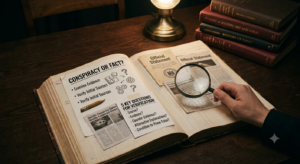
What Is a Conspiracy Theory?
Generally, a conspiracy theory refers to a mindset that interprets the cause of a significant event not through publicly known explanations, but as a plan secretly devised and executed by a small, powerful group.
For instance, rather than explaining a simple accident as “just an accident,” it is viewed as “intentionally planned by someone.”
What matters here is that claiming “a secret plan exists” does not automatically imply the claim is false.
In reality, covert operations and illegal collusions do occur.
Thus, when evaluating a conspiracy theory, one must look at the quality of the evidence rather than the claim itself.
Why Do Conspiracy Theories Sound Plausible?
The first reason is that they provide a clear cause for complex events.
Real-world events often result from numerous intertwined variables.
However, conspiracy theories explain complex occurrences through a single intention and a single group.
An explanation that “someone planned it” often feels intuitively more natural to humans than “multiple events happened to overlap coincidentally.”
The second reason stems from existing power dynamics.
Entities like governments, major corporations, financial institutions, and intelligence agencies possess internal information inaccessible to the general public.
Hence, thinking “there might be information we don’t know” is inherently rational.
The problem arises when one takes a step further and uses the mere existence of unknown information as proof of a specific conspiracy.
Logical Structures Commonly Found in Conspiracy Theories
A primary example is the “unfalsifiable claim.”
If someone asserts a conspiracy, but when presented with counter-evidence, claims:
“That evidence is also part of the conspiracy,”
a fundamental issue occurs.
Under this logic structure, there is no need to abandon the initial claim regardless of what evidence emerges.
Consequently, the assertion becomes practically impossible to verify.
Another common pattern is the logical fallacy of post hoc ergonomics (connecting coincidences).
This occurs when someone concludes that Event A caused Event B simply because Event A happened closely prior to Event B.
Chronological sequence and causal relationship are entirely different matters.
Distinguishing Real Events from Conspiracy Theories
This distinction is particularly critical.
History contains actual instances where the misconduct of government agencies or corporations was exposed.
However, this does not mean every undisclosed event serves as evidence for a conspiracy theory.
For example, in 2018, the U.S. Securities and Exchange Commission (SEC) brought securities fraud charges regarding Elon Musk’s tweet about taking Tesla private, resulting in a settlement between Musk, Tesla, and the SEC.
At the time, the SEC stated that Musk’s tweet moved Tesla’s stock price by more than 6%.
This belongs to a different category than a “conspiracy theory regarding Tesla stock manipulation,” because it relies on verifiable materials from official law enforcement investigations and legal procedures.
5 Questions to Verify a Conspiracy Theory
When encountering a conspiracy theory, consider asking the following questions:
What is the original source? Check whether it stems from an individual’s video or social media post, or an official document.
Is there concrete evidence? Vague assertions like “it’s suspicious,” “it makes no sense,” or “someone is hiding it” do not constitute evidence. You need independently verifiable materials such as documents, data, audio recordings, or court records.
How does it address counter-evidence? A valid hypothesis must be adaptable when opposing evidence surfaces. If every counter-argument is dismissed as part of the conspiracy, it is likely not a testable hypothesis.
Are alternative explanations possible? Multiple explanations can exist for a single event. The most dramatic explanation is not necessarily the most accurate.
Are there conditions under which the claim could be proven false? This question is especially crucial. There must be clear criteria defining what conditions would make one admit, “I might have been wrong.”
Why Blind Disbelief Is Also Dangerous
Viewing information critically does not mean accepting every official statement without question.
Government or corporate announcements are also subjects for verification.
The most rational approach is applying the same strict standard to both sides.
An official statement does not automatically become fact, nor does a claim automatically become true simply because it contradicts official statements.
The credibility of a claim must be determined by the quality of the evidence, not the status of the claimant.
Conclusion
The best way to evaluate a conspiracy theory is not to decide whether to “believe it or not” from the outset.
Instead, treat the claim as a hypothesis and verify the evidence first.
Keep these three key points in mind:
The possibility that secrets exist differs from the actual existence of a specific conspiracy.
Suspicious circumstances are distinct from direct evidence.
A claim contradicting official announcements does not automatically make it true.
What is required in an era of conspiracy theories is not the inclination to doubt everything, but the ability to discern what to believe and to what extent.