I noticed a small crack in my car muffler and applied KG 900 silicone on it, which made me curious to check how long it actually takes to set.
At first, it is easy to think of it like regular silicone—assuming it will set in a few hours and be usable in about a day. However, looking at the intended use of KG 900, its nature is completely different from products used in automotive exhaust systems.
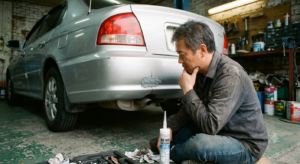
What Kind of Silicone is KG 900?
KG 900 is a one-component silicone sealant sold by Soudal Korea.
In the currently verified product information, its usage is listed for window glass glazing, among other things. In other words, it is not a product made for repairing automotive exhaust systems or mufflers.
Therefore, just because the product name contains the number ‘900’, you should not assume it can withstand 900°C.
The numbers in silicone product names and their heat resistance temperature are two entirely separate matters.
How Many Hours Exactly Does KG 900 Take to Cure?
There is an important point to note here.
On the currently accessible KG 900 product pages, information such as the product name, usage, and its status as a one-component silicone can be verified; however, the exact surface tack-free time and full curing time could not be confirmed on the public pages accessible to me.
Therefore, arbitrarily concluding for KG 900 that ‘it sets in 30 minutes’ or ‘it cures completely in 24 hours’ is inappropriate.
For silicone, the curing speed can vary not only depending on the product itself, but also due to application thickness, temperature, humidity, and the surrounding environment.
Especially when applied thickly, even if the surface hardens first, the interior does not necessarily cure at the same rate.
Thus, if you used KG 900 like standard silicone, you should not treat the hardening of the outer layer as synonymous with full interior curing.
So, What Will Happen to KG 900 Applied on a Muffler?
In this case, the operating temperature and intended use of the product are far more critical issues than the curing time.
A muffler is an exhaust system component through which exhaust gases generated by the engine pass. Because it is exposed to considerably high temperatures depending on driving conditions, using window silicone as a muffler repair material is improper.
Particularly at joint areas of a muffler where heat and vibration occur simultaneously, simply plugging the gap with silicone is difficult to maintain over a long period.
Consequently, even if KG 900 cures sufficiently, it does not become a suitable material for muffler repair.
General Silicone and Exhaust System Repair Materials are Different
For automotive exhaust systems, dedicated exhaust sealants, putties, and repair wraps/bands are sold separately.
For instance, Permatex sells dedicated sealants designed to prevent leaks in mufflers, tailpipes, and joints, offering product specifications with temperature resistance up to 1,000°C.
J-B Weld also sells a dedicated Exhaust System Sealant to seal gaps and joints in exhaust systems, which indicates a heat resistance of up to 454°C.
In short, even under the same term ‘sealant’, products for windows and products for exhaust systems have fundamentally different purposes of use.
What Should You Do If You Applied Silicone to a Muffler?
If you are in a situation where you need an immediate temporary fix for a few days due to a small crack, relying on the curing state of regular silicone is far less reasonable than using repair materials dedicated to exhaust systems.
Especially if the crack is not merely in the middle of a flat metal sheet but at a junction where pipes connect, products that account for heat and vibration—such as dedicated putty or exhaust repair wraps—are appropriate rather than applying silicone alone.
summary
KG 900 is not a repair product for car mufflers, but a one-component silicone sealant used for window glass glazing and similar applications.
Therefore, regardless of verifying the exact curing time of KG 900, recommending its use for muffler repair is difficult.
Particularly in areas where high heat and vibration occur at the same time like muffler joints, using dedicated exhaust system putty, sealant, or repair bands instead of regular silicone is correct.
I experimented with it directly myself, so please never use it on mufflers or similar parts. Also, if possible, never let cars or motorcycles get rained on.
If someone were in a financial position to constantly replace their car or motorcycle, they wouldn’t have gone through this kind of experience in the first place.
To use what you have in the best possible condition for as long as possible, it is best to avoid doing anything that causes the body to decay and rust.