“Who rules the world?”
This question is far more complex than it appears.
Some might immediately point to the President of the United States, while others think of the U.S. as a nation. Still others might recall massive financial institutions, global corporations, or international organizations.
Online, conspiracy theories persist, alleging that specific families or secret societies control the world from behind closed doors.
However, examining this issue from a realistic perspective leads to a different conclusion.
Based on current verifiable evidence, there is no foundation to claim that a single individual or secret organization governs the entire globe.
This does not mean world leaders or power holders do not exist.
Instead, the key question is not who rules everything, but which entity can influence the choices of other nations and people in specific domains.
Politics, military, finance, trade, technology, energy, information, and culture each operate under distinct power dynamics.
Consequently, global power resembles an interconnected network of massive power structures rather than a single pyramid.
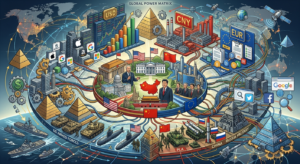
Understanding Global Power Requires Categorizing ‘Power’
Evaluating national strength solely by GDP or military capacity distorts global dynamics.
For instance, a country may possess formidable military might yet wield minor influence in global financial markets.
Conversely, an economic zone with modest military power can, through a massive market, compel foreign corporations and governments to abide by its rules.
Global power can be categorized as follows:
| Type of Power | Core Mechanism / Instrument | Key Entities |
| Political Power | State institutions, diplomacy, law | US, China, EU, etc. |
| Military Power | Armed forces, nuclear arsenals, alliances | US, China, Russia, etc. |
| Economic Power | GDP, industries, trade, consumer market | US, China, EU, etc. |
| Financial Power | Currency, financial markets, payment networks | US & Major Financial Hubs |
| Tech Power | Semiconductors, AI, platforms, cloud computing | US, China & Big Tech |
| Information Power | Search engines, SNS, video streaming, media | Global platforms & Media giants |
| Regulatory Power | Market rules and legal frameworks | US, EU, etc. |
This breakdown clarifies why naming a single ruler of the Earth remains impossible.
Is the United States the Most Broadly Powerful Nation Today?
It is impossible to discuss the global power structure without mentioning the United States.
The U.S. combines a large economy with military dominance, financial leverage, technological leadership, diplomatic clout, and global corporate influence.
According to 2025 World Bank data, nominal U.S. GDP reached approximately $30.8 trillion, exceeding China’s roughly $19.5 trillion.
Yet economic size alone does not fully explain American leverage.
Military Power: In 2025, U.S. defense spending reached approximately $954 billion—the highest globally. According to SIPRI, this accounted for about 33% of total global military expenditure. China ranked second with roughly $336 billion, while Russia ranked third with around $190 billion. A substantial gap remains between the U.S. and other nations in military terms.
Dollar & Financial System: The U.S. dollar serves as another major axis of American power. IMF COFER data indicates that in Q4 2025, the U.S. dollar comprised about 56.77% of allocated global foreign exchange reserves, compared to the Euro at 20.25% and the Chinese Yuan at 1.95%. This reserve status means American financial markets and monetary policies significantly shape the broader global economy.
Is China a Counterweight to the United States?
China remains indispensable to global power discussions.
With a 2025 nominal GDP of roughly $19.5 trillion according to the World Bank, China stands as the world’s second-largest economy.
Its core advantages reside in a vast domestic market and manufacturing foundation.
Chinese influence spans key strategic sectors:
Manufacturing & Global Trade
Supply Chains & Strategic Resources (e.g., Rare Earths)
Infrastructure Investments & Regional Influence in Asia
Rapid Expansion in Military Capabilities & Tech Industries
SIPRI reports China’s 2025 military spending reached approximately $336 billion—a 7.4% increase from the previous year.
Describing global dynamics as “total U.S. dominance” is inaccurate.
A more precise assessment is that while the U.S. commands the broadest range of influence, China has emerged as a challenger across economic, industrial, and military spheres.
Russia: Military Power Outweighing Economic Scale
Assessing Russia purely by GDP misses critical geopolitical realities.
While its economic output is smaller than that of the U.S. or China, Russia wields significant influence through its nuclear capabilities, military posture, energy resources, and strategic geography.
SIPRI data highlights Russia’s 2025 defense spending at approximately $190 billion, ranking third globally.
This illustrates that global power does not correlate strictly with GDP.
National power comprises a composite mix:
Russia exemplifies a nation whose global footprint relies heavily on military capacity, energy reserves, and geopolitical position.
Why the European Union (EU) Remains a Power Hub Without Being a Sovereign State
The European Union presents a unique model.
Though not a sovereign nation like the U.S. or China, the EU exerts substantial influence over global commerce and corporate conduct.
Its primary mechanism is regulatory power—the capacity to set strict compliance rules for companies seeking access to its lucrative consumer market.
A clear example is the Digital Markets Act (DMA).
The European Commission enforces oversight on designated “gatekeepers”—including Alphabet, Amazon, Apple, ByteDance, Meta, Microsoft, and Booking—covering 23 core platform services as of 2026.
When multinational firms alter global operations to comply with EU directives, those standards often become global benchmarks.
Evaluating EU influence solely through military metrics understates its true reach.
Do Global Corporations Rule the World?
Tech giants like Apple, Microsoft, Google, Amazon, and Meta exert influence across consumer hardware, operating systems, search engines, social media, cloud infrastructure, and AI ecosystems.
However, corporate power and state sovereignty remain distinct:
Corporations command economic capital, technological architecture, and user attention, but lack legislative authority, tax enforcement powers, or control over armed forces.
States hold legal jurisdiction and military authority, but rely on private enterprises for technological innovation and commercial infrastructure.
Modern governance features an interdependent relationship where state authority and corporate power overlap and negotiate continuously.
Information Platforms as the New Axis of Power
Power historical definitions centered on land control and armed forces.
In the digital age, managing, filtering, and directing information flows constitutes a vital dimension of power.
Algorithms governing search engines, social feeds, and recommendation systems shape public awareness, cultural narratives, and consumer choices.
The designation of Google Search, YouTube, Android, and Chrome under the EU’s Digital Markets Act underscores the systemic influence of these digital channels.
Platforms shape information environments and structure choice architectures rather than exercising direct, total control over individual minds.
Distinguishing Financial Influence from Total Domination
Massive central banks and international financial institutions are sometimes viewed as hidden rulers of the global economy.
The U.S. Federal Reserve’s interest rate decisions ripple across international exchange rates, capital flows, equity markets, and emerging economy debt dynamics.
However, influencing global markets differs from ruling the world.
Central banks operate within strict legal mandates and domestic economic parameters.
Institutions like the IMF and the World Bank possess global reach, yet they do not function as a unified world government.
The Real Architecture of Global Power
Global authority operates across a multi-tiered architecture:
Sovereign States: Nations like the U.S., China, Russia, India, and Japan exercise legal authority, military forces, and formal diplomacy.
Economic Blocs: Major commercial arenas—such as the U.S., China, and the EU—shape global trade rules and supply chain flows.
Financial Systems: Reserve currencies (Dollar, Euro), central banks, and capital networks control global liquidity.
Multinational Enterprises: Tech, energy, and semiconductor firms provide the physical and digital infrastructure of modern commerce.
Information Networks: Search algorithms, social platforms, media outlets, and digital services govern information distribution.
These layers interlock.
A U.S. technology firm raises capital in American capital markets, relies on Asian manufacturing supply chains, complies with European Union regulations, and delivers services to a global user base.
Global power operates as an interconnected network of competing and overlapping entities rather than a centralized command structure.
Limitations of ‘Global Influence Rankings’
Reducing global influence to a simple 1-to-10 ranking oversimplifies complex geopolitics.
While the U.S. leads in defense spending—accounting for ~33% of global defense budgets—and financial settlement infrastructure, the EU leads in regulatory standards, and China dominates industrial manufacturing capacity.
Arbitrary scores like “US: 90, China: 80, EU: 75” serve as illustrative models rather than standardized scientific metrics.
Conspiracy Theories vs. Structural Realities
Complex global networks lead some to suspect a hidden cabal directing world events behind the scenes.
Corporate lobbying, state diplomacy, and multilateral summits reflect visible, strategic interactions among powerful actors, not secret global control.
Asserting that a single secret organization directs all global affairs requires verifiable documentary evidence, structural oversight mechanisms, and financial trails that do not exist.
Conclusion: No Single Entity Holds Absolute Control
Answering “Who rules the world?” with a single name or entity oversimplifies global realities.
While the United States remains the most broadly influential nation across military, financial, economic, and technological spheres, it cannot dictate global outcomes unilaterally.
China exercises independent leverage through its manufacturing dominance, economic scale, and growing military posture.
Russia leverages nuclear deterrence, energy exports, and strategic positioning.
The EU shapes corporate practices globally through regulatory frameworks.
Multinational tech platforms structure digital communications and information delivery.
Global power is distributed across competing sectors: state armies hold military power, the U.S. dollar dominates international finance, tri-polar economic blocs drive commerce, and tech platforms shape the information landscape.
Rather than a single hidden ruler, the modern world is defined by a multi-layered power matrix where sovereign states, regulatory bodies, financial networks, and global enterprises continuously compete and collaborate.
However, there is clear structural momentum toward the power base becoming concentrated among a continuously shrinking number of people.
We must also deeply contemplate the path forward for democracy as it continues to counter absolute monarchies and one-man dictatorships.
This is because once military command and police power fall into the hands of a single individual, that person will inevitably refuse to tolerate any political rivals.