Is the statement that “consciousness is also a vibration” scientifically correct? To what extent is the claim that consciousness is a vibration actually true?
Answering this question requires distinguishing between consciousness itself and the physical phenomena observed in the brain when consciousness arises.
In the human brain, the electrical activity of neurons changes over time, and the activities of multiple neurons form certain rhythms. These activities can be measured through electroencephalography, commonly known as EEG. Actual research also observes a link between the rhythmic activity of the brain and conscious perception.
However, one cannot immediately conclude from this that consciousness itself is vibrational energy.
This is because the fact that vibrations are observed in the brain and the claim that the essence of consciousness is vibration are two separate propositions.
Understanding this distinction requires first examining what sound, light, resonance, and brainwaves are as individual phenomena.
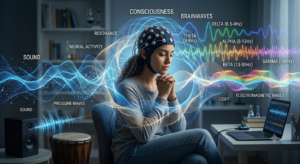
Sound and light are both related to wavesSound is a phenomenon in which the vibration of matter is transmitted
Sound is a phenomenon where objects vibrate, creating pressure changes in the surrounding matter, and those changes are transmitted as waves.
For example, when you strike a drum, its surface vibrates. This vibration creates pressure changes in the surrounding air, and when those pressure changes reach the ears, you hear sound.
The frequency of sound is the number of vibrations repeated per second, with the unit being hertz (Hz).
Higher frequencies are generally heard as higher pitches, and lower frequencies as lower pitches.
However, sound requires a medium such as air or water to travel. Normal sound is not transmitted in a vacuum.
Light is an electromagnetic wave
Light is also a wave, but it differs from sound.
Light is not transmitted through the vibration of air molecules, but is an electromagnetic wave in which changes in electric and magnetic fields propagate.
When the frequency of light changes, its color also changes. Within the visible light spectrum, red is located at the lower frequency end, and violet at the higher frequency end.
Light can propagate even in a vacuum.
As such, while sound and light share the common characteristic of being waves, their physical properties and transmission methods differ.
Therefore, all waves should not be treated as a single identical energy.
Why vibration can achieve significant effects through resonance
Resonance is a phenomenon where a specific vibration can increase significantly when the frequency of an external periodic stimulus matches the natural oscillation characteristics of a system.
Understanding resonance through the movement of a swing
Thinking of a swing makes it easy to understand the principle of resonance.
When a swing moves back and forth, adding force at the appropriate timing makes the swinging motion progressively larger.
Conversely, if the timing is off, applying force may not make the movement as large as expected.
This is because the energy supplied from the outside meshes appropriately with the movement of the system.
However, resonance does not create energy out of nothing.
Rather, energy supplied from the outside accumulates within the system, or the amplitude of a specific vibration increases.
The extent to which it actually increases depends on damping, the magnitude of the external stimulus, and the characteristics of the system.
Resonance does not apply equally to all phenomena
Resonance is utilized not only in mechanical vibrations but also in electrical circuits and acoustic systems.
However, matching the frequency of any system does not mean infinite power can be obtained.
To achieve significant effects through resonance, the manner in which energy is delivered to the system and the energy lost must be considered together.
The same applies when applying this principle to the brain and consciousness.
The mere existence of rhythmic activity in the brain does not warrant the assertion that the general resonance principles of mechanical devices govern consciousness as a whole.
What are brainwaves, and what is their relationship with consciousness?
Brainwaves are signals measuring the electrical activity of the brain from the scalp.
These signals contain activities of various frequencies, and research often separates and analyzes activities in specific frequency bands.
| Brainwave Band | Generally Used Frequency Range | Related Phenomena Examined in Research |
| Delta waves | Approx. 0.5–4 Hz | Deep sleep and slow brain activity |
| Theta waves | Approx. 4–8 Hz | Sleep, memory, and cognitive processes |
| Alpha waves | Approx. 8–13 Hz | Resting state and sensory information processing |
| Beta waves | Approx. 13–30 Hz | Various cognitive and motor-related activities |
| Gamma waves | Above 30 Hz | Sensory information integration and various neural activities |
This range is a rough division commonly used in research and does not hold the exact same meaning for every person and in every situation.
In particular, the observation of a specific brainwave does not mean that a person is necessarily in a specific state of consciousness.
Multiple frequency bands can appear simultaneously, and activities within the same frequency band can carry different meanings depending on the measurement location, task, and individual state.
Brainwaves and consciousness are connected but not identical concepts
Brainwaves are the measured result of the brain’s electrical activity.
Consciousness is related to the phenomenon where we experience and perceive things and become aware of our own experiences.
An important connection exists between the two concepts.
Changes in brain activity can alter states such as perception, attention, sleep, and arousal.
However, no evidence suggests that a single specific frequency of brainwaves explains consciousness as a whole.
Understanding brain activity related to conscious experiences requires examining the interactions among multiple neurons and brain regions.
Can sound tune brainwaves to a specific frequency?
A hypothesis suggests that playing sounds of a specific frequency causes the brain’s electrical activity to shift and match that frequency.
This is studied under the concept of brainwave entrainment.
For example, binaural beats are a phenomenon where presenting slightly different sound frequencies to each ear results in the perception of a beating sensation corresponding to the difference between the two frequencies.
Whether such sound stimuli affect brainwaves and cognitive states is a subject of ongoing research.
However, one cannot conclude that simply playing sounds reliably forms desired brainwaves and produces specific mental effects.
A systematic review published in 2023 analyzed 14 studies investigating binaural beats and brainwave entrainment.
Among them, 5 studies reported results supporting the entrainment hypothesis, 8 reported opposing results, and 1 reported mixed results. Due to significant differences in research methodologies, evaluators noted that drawing clear conclusions is difficult.
Therefore, simply because music is labeled as “alpha music” or “theta music,” accepting that it reliably produces brainwaves of those frequencies is difficult.
People may experience relaxation or improved concentration while listening to music.
However, explaining that experience as occurring due to the resonance of specific brainwaves requires separate measurement and verification.
Are meditation and mantra repetition related to resonance?
Meditation and mantra repetition utilize breathing, attentional focus, and repetitive sound stimuli.
Whether these activities help relieve tension or regulate attention is a researchable question.
For example, breathing in a steady rhythm or repeating the same sound can focus attention on that rhythm or sound.
In that process, changes in breathing, arousal state, and brain activity may occur.
However, one should not immediately conclude that this is the result of consciousness resonating at a specific frequency.
What changes actually appear and through what mechanisms those changes occur must be verified individually.
The personal experience of feeling peace through meditation and the physical claim that a specific vibration amplifies consciousness need to be distinguished.
Is consciousness energy, then?
Discussing the relationship between consciousness and energy requires first clarifying what the word energy means.
In physics, energy is a quantitative physical quantity related to the capacity to do work.
Kinetic energy, potential energy, thermal energy, and electromagnetic energy each have defined meanings and measurement methods.
The brain consumes energy through metabolism to perform electrical and chemical activities.
Conscious experiences are also closely linked to brain activity.
However, this fact does not mean that consciousness itself is a separate form of energy.
The claims that consciousness is vibrational energy or resonates with a specific energy pervading the entire universe are not currently established physical facts.
The same applies to odic force or similar concepts. The actual existence of vibration and resonance does not serve as proof that a separate energy exists.
Conclusion
Sound and light are actual physical phenomena related to waves, and resonance is a principle that greatly increases the amplitude of specific vibrations under certain conditions.
Rhythmic electrical activity is also observed in the brain, and such activity plays an important role in research concerning consciousness and perception.
However, three distinctions must be made here.
First, vibration and resonance are concepts of real physics.
Second, a verified connection exists between brainwaves and conscious experiences.
Third, claims that consciousness itself is vibrational energy and acquires supernatural powers when resonating with a specific frequency must be verified separately.
Therefore, while studying consciousness from the perspective of vibration is meaningful, treating actually measured brain activity and unproven mystical explanations as the same thing is important to avoid.